1944 dime value often seems straightforward. The year is common. Millions were struck. The coin is easy to find in worn grades.
Yet auction records show extremely high prices for certain examples that may impress you.
So the real question is: is 1944 just another common piece, or can it be a true rarity?
Basic Overview of the 1944 Mercury Dime
The 1944 issue is part of the Mercury dime by Adolph A. Weinman. The coin depicts Liberty (resembling the god Mercury, after whom the coin received its nickname) wearing a winged cap on the obverse and a fasces with an olive branch on the reverse.
Main Characteristics:
Composition: 90% silver, 10% copper
Total weight: 2.50 grams
Pure silver content: 0.0723 troy ounce
Diameter: 17.9 mm
Edge: Reeded
There were no mental changes in 1944. The United States Mint continued striking 90% silver dimes during World War II. The alloy remained stable. The design did not change. There were no transitional elements.
From a structural standpoint, 1944 is a standard wartime silver issue.
Mintage by Mint: High Production Numbers
Official mintages were strong across all facilities.
Mint | Official Mintage |
1944 (Philadelphia) | 231,410,000 |
1944-D | 62,224,000 |
1944-S | 49,130,000 |
Philadelphia produced over 231 million pieces. Denver struck more than 62 million. San Francisco added over 49 million.
None of these figures suggests rarity. Even the lowest mintage exceeds many earlier Mercury dime key dates by a wide margin. On paper, the 1944 dime is not scarce.
However, mintage and survival are different concepts. Many coins entered circulation immediately. Most saw heavy use. That distinction becomes critical when discussing higher grades.
Were There Proofs in 1944?
The Mint did not produce official proof Mercury dimes in 1944. Proof production for regular coinage had been suspended during the war years.
Some circulation strikes display reflective fields and are sometimes described as “prooflike.” These are not official proof issues. They are standard business strikes with unusually sharp surfaces. In rare cases, prooflike coins may also qualify for Full Bands designation.
Prooflike does not mean a separate issue. It is a surface characteristic, not a different type.
Value Nuances
Circulated Value: The Silver Floor
In lower grades, the 1944 dime behaves primarily as bullion.
With 0.0723 troy ounce of silver, the coin carries intrinsic value tied to the silver market. When silver rises, the base value rises. When silver falls, the floor drops.
In grades such as Good, Very Fine, and even Extremely Fine, premiums above melt are modest. The coin is available in quantity. Collectors can acquire circulated examples without difficulty.
In these conditions, 1944 is common. There is no condition rarity at this level.
Mint State: Where the Separation Begins
The real shift occurs in Mint State. Below you can see a simplified market structure based on typical certified examples.
Grade | 1944-P | 1944-D | 1944-S |
MS63 | modest premium | modest | modest |
MS65 | clear premium | stronger | stronger |
MS66 | strong | stronger | stronger |
MS67 | significant | significant | very strong |
MS67 FB | premium tier | strong premium | very strong premium |
MS68 | rare | rare | extremely rare |
MS63 coins remain accessible. MS65 examples bring stronger collector interest. At MS66, prices rise more noticeably. MS67 represents a major step. Supply tightens. Registry collectors begin competing.
MS68 coins are extremely rare. Few have been certified. Auction records confirm how scarce this level truly is.
At this stage, the discussion changes from mintage to preservation.
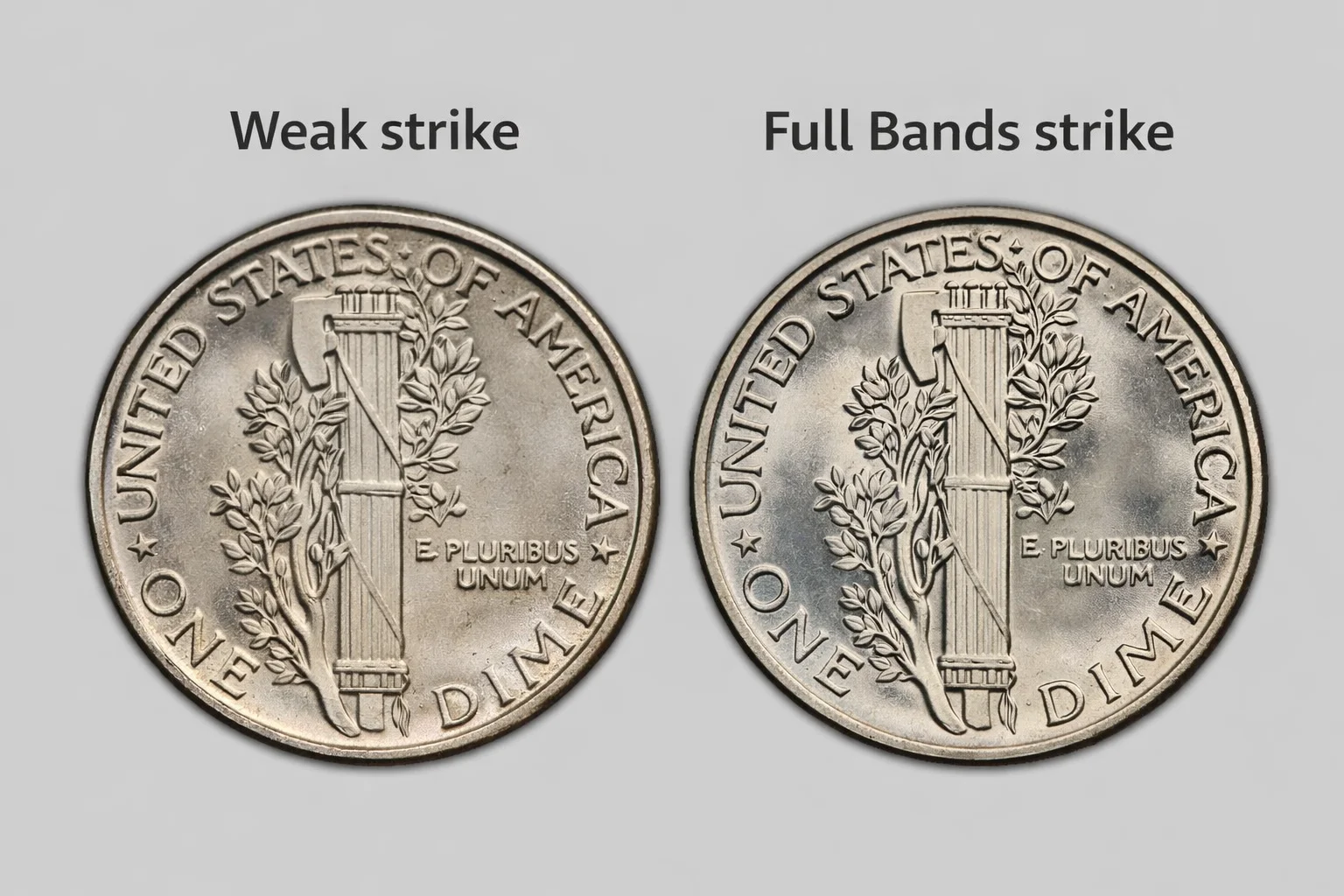
Full Bands: The Real Divider
For Mercury dimes, the Full Bands (FB) designation plays a central role in value.
The reverse design features horizontal bands across the fasces. To qualify for FB, these bands must show full separation and sharp definition. Any weakness reduces the designation.
Why does this matter?
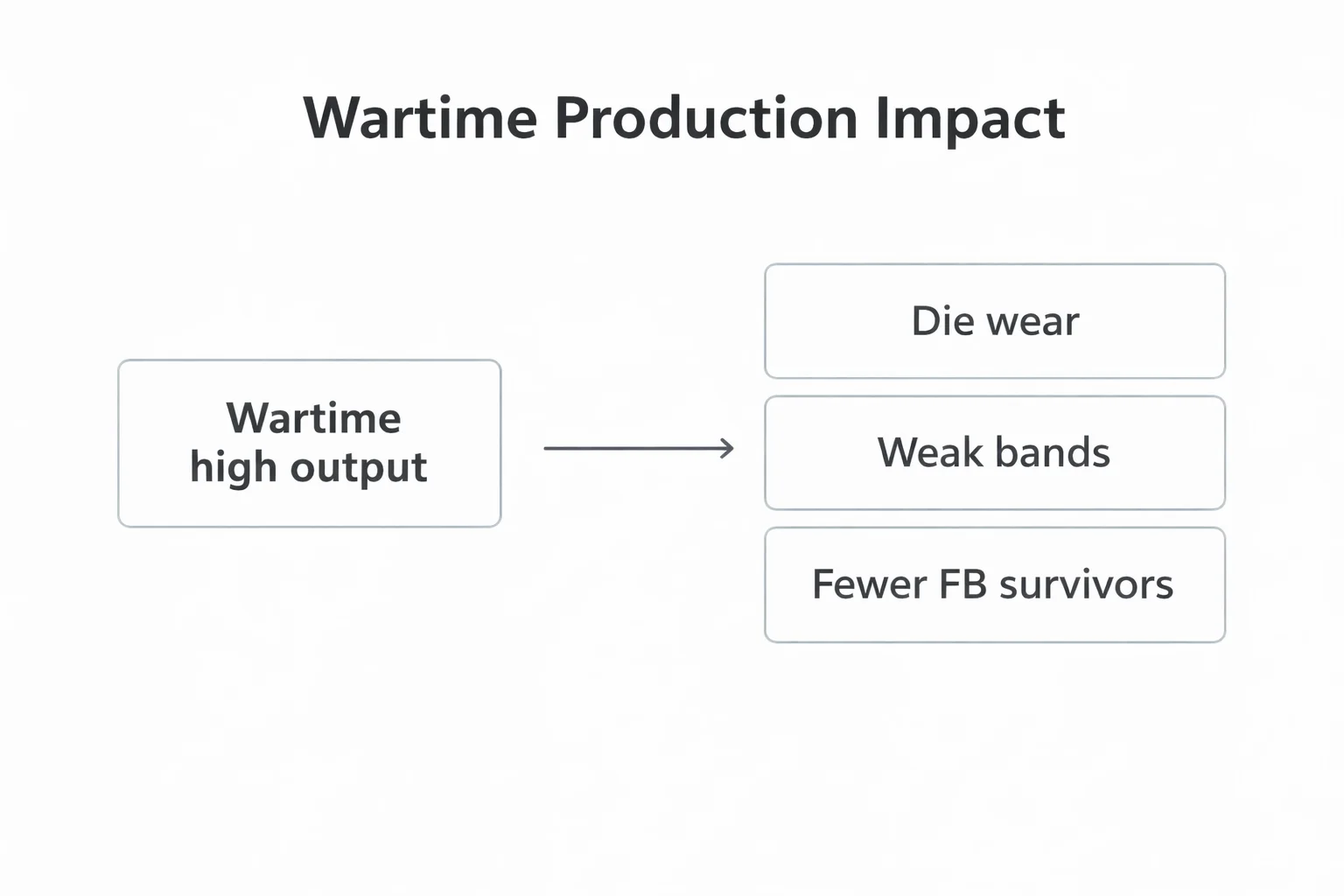
High-speed wartime production led to die wear. As the dies deteriorated, fine details weakened. Many coins left the Mint without complete band separation. Even coins that survived in Mint State may not meet FB standards.
The difference between MS67 and MS67 FB can be dramatic. FB examples often sell for multiples of non-FB coins at the same numeric grade.
This is where condition rarity emerges. The coin is common. The fully struck coin is not.
Verified Auction Records
Market data confirms this pattern.
Auction Record: $1,410 for MS67+ at Heritage Auctions
Auction Record: $25,300 for MS68 FB at Bowers & Merena
These are not ordinary sales. They represent the highest end of the grading scale. An MS67+ example already commands strong money. An MS68 brings exceptional results.
These numbers illustrate the core point. The year is not rare. The grade is.
Strike Quality in 1944
The 1944 issue reflects wartime production pressure.
Dies were used heavily. Replacement schedules were aggressive. Quality control focused on volume rather than aesthetic perfection.
Common strike issues include:
Weak central detail
Incomplete band separation
Soft facial features
Reduced sharpness in lettering
Differences between mints also appear. Some Denver and San Francisco pieces show weaker strikes. Philadelphia coins are abundant but not always sharply defined.
Strongly struck examples are less common than raw mintage figures suggest.
Comparing 1944 with Neighboring Years
The 1943 and 1945 dimes share similar characteristics. All were struck in 90% silver. All were produced in large numbers.
However, subtle differences in die preparation and survival patterns influence top-grade populations. In some grading tiers, 1944 proves more difficult than casual collectors expect.
No major transitional change separates 1944 from adjacent years. Its distinctiveness comes from how many coins fail to reach the highest quality thresholds.
Understanding Condition Rarity
A common date means high mintage and wide availability in circulated grades.
Condition rarity describes a different situation. It occurs when large numbers are produced, but few survive in top condition.
The 1944 Mercury dime fits this definition precisely.
In worn grades, it is common. In MS65, it is collectible. In MS67 FB, it becomes scarce. In MS68, it reaches exceptional rarity.
This layered structure defines its market identity.
Practical Evaluation Strategy
When evaluating a 1944 dime:
Confirm weight at 2.50 grams.
Inspect bands for full separation.
Rotate under light to check luster.
Look for cleaning marks.
Compare strike strength across key areas.
If you are not sure about minting details and the estimated value, try the Coin ID Scanner app to answer questions, but remember to learn other nuances and grading by yourself.
Final Answer: Common Date or Condition Rarity?
The 1944 Mercury dime is common by production numbers. It is widely available in circulated grades. It carries strong silver content and stable bullion value.
But at the upper end of the grading scale, the story changes.
MS67 examples are limited. MS67 FB coins are scarce. MS68 pieces are rare at an exceptional level, as auction results confirm.
The year itself does not create value, but reservation, strike quality, and Full Bands designation do.